A kyabakura is a Japanese hostess club where you buy time at a table, and the woman sitting with you is paid to pour your drinks and keep the conversation alive. The price arrives as four or five separate charges rather than one number, and Roppongi clubs publish a range of ¥30,000 to ¥80,000 ($189 to $505) for a single guest’s night. I have paid that bill and watched it get assembled line by line while I was still enjoying myself. The meter is the product, and understanding it is the whole difference between a good night and a stupid one.
A kyabakura sells you time, not the woman
What you buy at a kyabakura is a block of minutes with a hostess whose job is to sit at your table, top up your glass and carry the talk. The staff are called kyabajō and most of them work under a professional name rather than their own, which sets the terms of the evening before either of you has said anything. Sexual services are not part of the arrangement and the clubs are direct about it. Nouvelle Style Group, an operator running ten venues around Nagoya, states on its own English guide page that sexual services are not provided and that the club is not a venue for outside dating. The whole category sits under the Businesses Affecting Public Morals Regulation Act, which requires a permit, brings regular Public Safety Commission inspections and forbids sexual contact between staff and customers.
None of that stops the room from feeling like something else, which is precisely the thing you are paying for. A competent hostess makes an hour disappear and leaves you convinced you were interesting company. I have walked out of a club in a perfectly fine mood and only worked out on the train home that I had spent the whole evening being expertly managed. That isn’t a complaint about her, because she was doing a difficult job extremely well. It is a note to myself about what I had actually purchased.
The bill is built from four separate charges
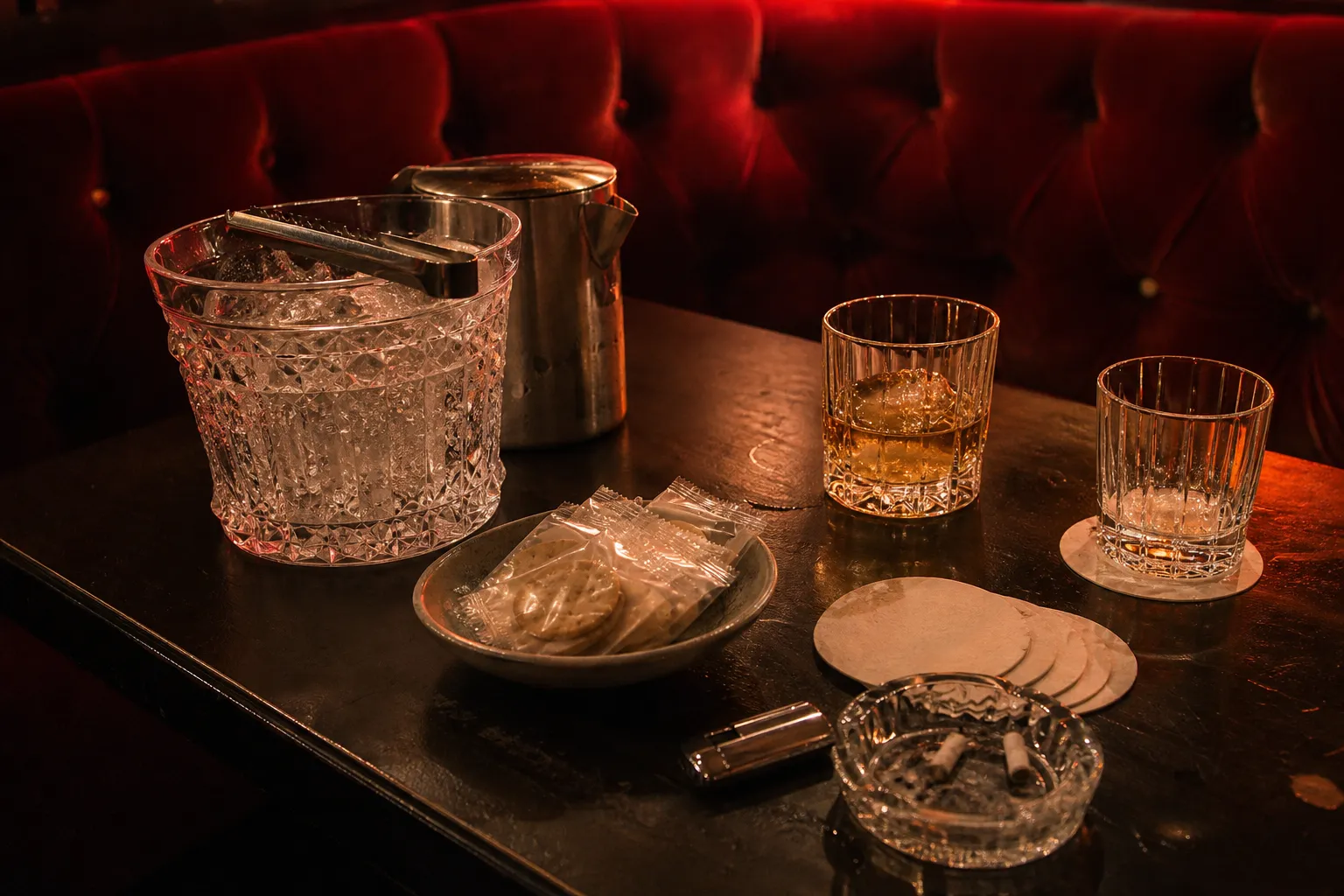
Your final number is a set charge, a table charge, every drink on the table including hers, and then a percentage added at the end. LUNE, a Roppongi club that publishes its rates in English, lists the set charge as an hourly base of ¥5,000 to ¥10,000 ($32 to $63), a table charge on top of that at ¥3,000 to ¥5,000 ($19 to $32), and drinks at ¥1,500 to ¥3,000 ($9 to $19) each. Service charge and tax land at the very end and usually run 15 to 20 percent of everything above them. The same page puts a normal visit at ¥30,000 to ¥80,000 ($189 to $505) per guest, which matches what I have paid on nights when I ordered nothing ambitious at all.
The line that quietly does the damage is the hostess drink. Her glass sits on your tab, she is encouraged to keep it moving, and at ¥1,000 to ¥3,000 ($6 to $19) a time it compounds considerably faster than your own drinking does. Nouvelle Style Group prices a cast drink at its girls’ bars at ¥1,000 ($6), which is the cheap end of this market and still stacks up over a couple of hours. Nobody hides the charge and nobody announces it either. It simply appears at the bottom of the receipt, and by then you have bought eleven of them.
The clock runs in sets and an extension is a whole new one
Time at a kyabakura is sold in fixed blocks called sets rather than by the minute, so walking out ten minutes into a fresh one costs you the same as staying the entire way through. Nouvelle Style Group publishes 50 minutes for a standard set and 45 minutes for a daytime cabaret or a girls’ bar. LUNE sells its own lounge product at ¥18,000 ($114) for 60 minutes with house drinks and tax included, which is the transparent end of this business and unusual enough that the club leads its marketing with it.
What happens at the end of a set is the part I wish somebody had explained to me before my first one. Nobody ever says that your time is up in those words. A manager appears at the table, mentions the set in the politest possible phrasing, and the choice you are being offered is to settle now or buy another entire block. In a warm room with a drink in your hand and a conversation halfway finished, buying another block feels like nothing whatsoever. That is exactly how the ¥30,000 evening turns into the ¥80,000 one, and it never arrives as a single decision you would recognise at the time as expensive.
Nomination is the part that keeps you coming back
Nomination, or shimei, means naming a specific hostess for your table and paying a fee for the privilege, charged per set rather than once per evening. Once you have nominated her she takes a percentage of what you spend from that point onward, so her income is tied directly to how often you return and how much you order when you do. Clubs support the whole arrangement with bottle keep, where you buy a bottle that stays behind the bar under your name and waits for your next visit. The system is engineered so that your second night is worth appreciably more than your first.
This is where a kyabakura stops being an evening out and becomes a relationship with an invoice attached to it. There is a further step called dohan, where a hostess accompanies a customer somewhere before her shift starts, and that dinner is naturally on you as well. Historically a great deal of this ran on corporate money rather than personal money, and Wikipedia’s account of the trade notes one establishment where roughly 90 percent of tabs were reportedly settled by companies. Paying for all of it out of your own pocket is a completely different experience, and the men who fare worst in these rooms are the ones who have quietly forgotten which of the two they are doing.
The language, not your passport, is the real door
The barrier for a foreigner at a kyabakura is Japanese rather than any policy against you at the entrance. Japanese is the primary language in most of these clubs and the entire product being sold is conversation, so a table where neither of you can hold one is a poor purchase for everybody involved. Venue guides written for foreign visitors point at Roppongi as the district where this actually works, because a decent share of the hostesses there are accustomed to serving international guests and some speak English well enough to carry a full hour. Kabukicho in Shinjuku has far more venues packed into far less space, and the same guides warn plainly about the street touts working the pavement outside them.
My own rule after a handful of these nights is simple enough to state in one line. I never follow anybody who approaches me on the street, I go to a club that publishes its rates in a language I can read, and I ask what a set costs and what nomination costs before I sit down anywhere. Every honest place answers both questions without hesitating for a second. The ones that turn vague about it are telling you something quite useful, free of charge, while you still have the option of leaving. That instinct is the same one that keeps you solvent on dating apps in Japan, where the money also hides in the renewal rather than the sign-up.
What the money buys, and when I would skip it
For your ¥30,000 to ¥80,000 ($189 to $505) you get a comfortable room, attentive company and an hour in which somebody is genuinely skilled at making you feel worth listening to. That is a real service and I have never thought of it as fraudulent in any way. It is also, in the plainest available terms, rented attention, and the quality of your night depends almost entirely on whether you can hold both of those facts in your head simultaneously.
I would skip it if you are lonely rather than curious, because a kyabakura is very good at feeding the first condition and will keep doing so for as long as your card keeps working. I would skip it if you can afford the floor of that range but not the ceiling, since the floor is not where these evenings tend to finish. And I would skip it if you carry any expectation that the night goes somewhere afterwards, because the rules, the law and the woman herself have all already told you that it does not. Go once because you want to understand how one of Japan’s stranger industries really operates, spend the amount you decided on before you walked through the door, and treat the extension as the real decision it always was.
A happening bar in Japan is a completely different kind of night with a different rulebook altogether, and Tobita Shinchi in Osaka sits at the far end of the same country’s economy of paid attention. The kyabakura sits somewhere in the middle of those two, and it is the one that most reliably gets mistaken for something it isn’t. The same mistake shows up everywhere else in dating across Asia as a Western man, usually with a smaller receipt attached to it.
Is a kyabakura the same thing as a host club?
No, the roles are reversed, though the machinery underneath is nearly identical. A host club employs men who entertain female customers, and it runs on the same set charges and nomination fees. The spending at the top end goes considerably higher, with champagne tower celebrations reported at ¥500,000 to ¥1,000,000 ($3,158 to $6,316) and often well beyond that.
Do I need to speak Japanese to go to a kyabakura?
You do not strictly need it, but you need somewhere that has planned for you. Japanese is the working language in most clubs, so a venue in Roppongi with English-speaking hostesses is the sensible starting point for a first visit. A translation app on the table is workable and slightly grim, and it will not save an hour that neither of you can fill.
How much should I budget for one visit?
Budget the ceiling rather than the floor, which means somewhere around ¥80,000 ($505) if you intend to stay past a single set. A conservative first visit of one set with two or three drinks and no nomination sits closer to the ¥30,000 ($189) end. The gap between those two numbers is almost entirely made of extensions and hostess drinks.
Can I date a hostess I met at a kyabakura?
The clubs say no, and they say it in writing rather than by implication. Nouvelle Style Group states directly that its venues are not for outside dating, and the licensing regime treats the boundary as a legal condition of operating. Men do try regardless, and the ones who spend hardest are usually the ones trying hardest.