Manila nightlife, for a foreigner, mostly means Poblacion, a small district in Makati that locals shorten to Pobla. It’s a former red-light district that has turned into the city’s busiest bar neighbourhood, and the part I’d plan around is that people still live there. The bars are packed into old houses, the streets double as car parks, and the price of a beer depends heavily on which of the three or four versions of the city you walk into.
Poblacion Is the Part of Manila Everyone Means
Most guides send a visitor to Poblacion first, and PhilSTAR Life describes it as Makati’s first settlement and the seat of city government, second only to the central business district for commerce. By day it’s malls and offices. After dark the same streets turn into Pobla, a crowd that the magazine contrasts with the older Manila haunts of Cubao, Morato and Ermita, where the previous generation did its going out.
I find that contrast useful because it tells me who I’ll be standing next to. The magazine’s picture of Pobla is young, local and phone in hand, with clubs full even on weekdays, while it calls Bonifacio Global City a facade and the university belts around Katipunan and Morayta a student crowd waiting to graduate. That is one writer’s opinion, so I treat it as a rough sorting of the city rather than a verdict on any district.
The Old Red-Light Streets Are Still in the Frame
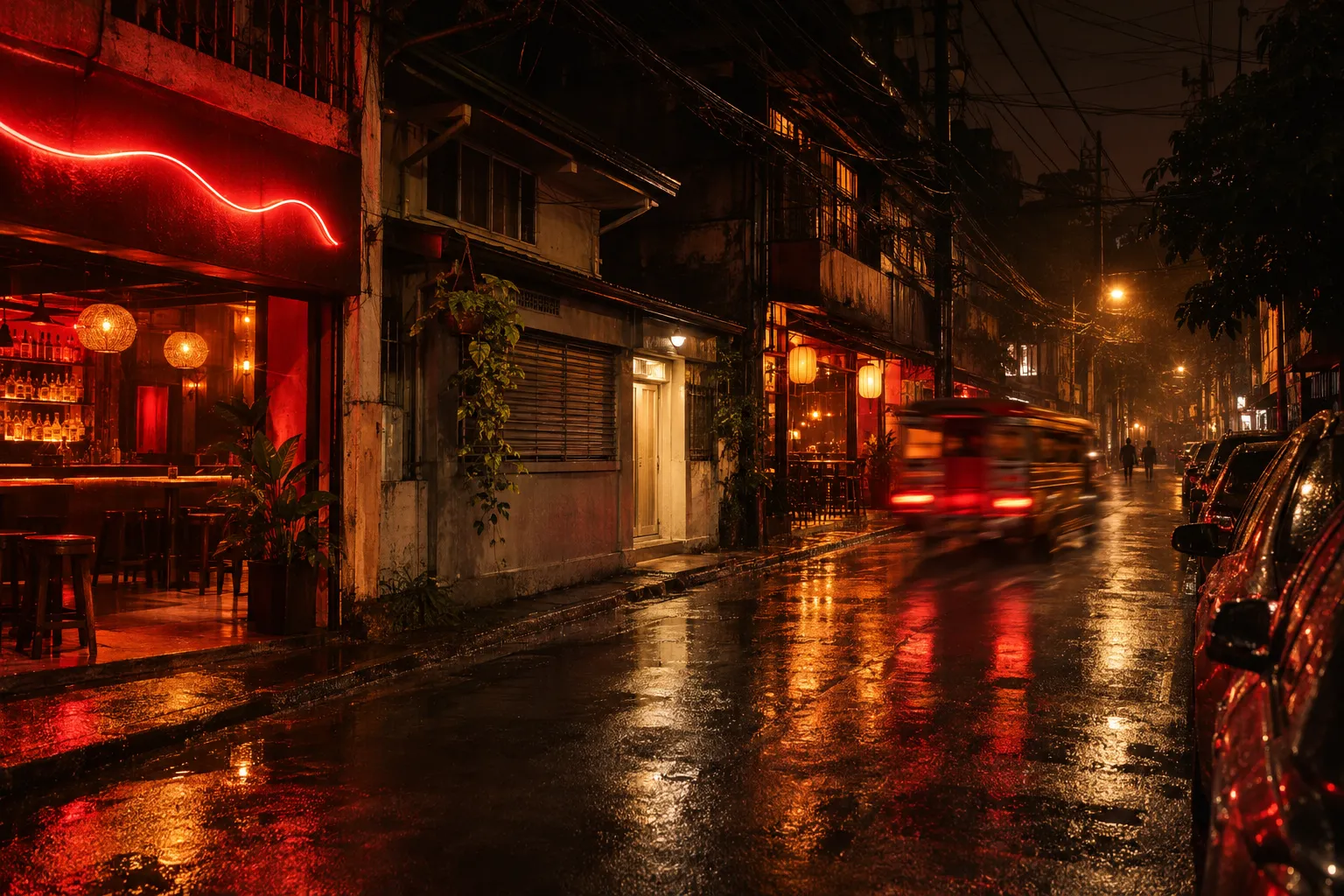
Poblacion’s past as a red-light district isn’t hidden history. PhilSTAR Life notes that the beer houses and strip clubs along P. Burgos Street are vestiges of that origin, and that the same street ends at a three-storey retro diner that has become a vlogger stop. Vice made the same point in 2019, saying the district grew into a creative enclave over about five years.
I’m not going to describe what happens inside those older venues, because I haven’t reported on it and this isn’t a notebook entry about paying for company. What I can say is what a visitor sees from the pavement. Neon, a doorman or two, a diner with a Cadillac in the dining room, and a block further on a cocktail bar with a drag show. The street doesn’t separate its eras, which is both the charm and the confusion of it.
The Crowd Splits Into Floors and Rooftops
The newer venues sit a few streets away from that strip, around Kalayaan Avenue, Fermina Street and Don Pedro Street. PhilSTAR Life names Tango, Guilt and Apothecary on Fermina as clubs gaining ground with Gen Z, a three-storey building called The Bolthole where each floor is its own dance room, and rooftop spots such as Sanctuary and Lynx. It also says a Caribbean rum bar called Buccaneers is always full of foreigners.
I’d read those names as a snapshot rather than a map. Bars in a district like this open, rename and close all the time, and the magazine itself mentions one cocktail bar that was temporarily shut while the piece was being written. Years ago, in the pandemic, Grid Magazine reported that a lot of the street’s businesses had closed outright, and Poblacion came back anyway. That tells me the strip is resilient, but not that any particular bar will still be there next month.
Residents Are the Reason the Volume Is a Story
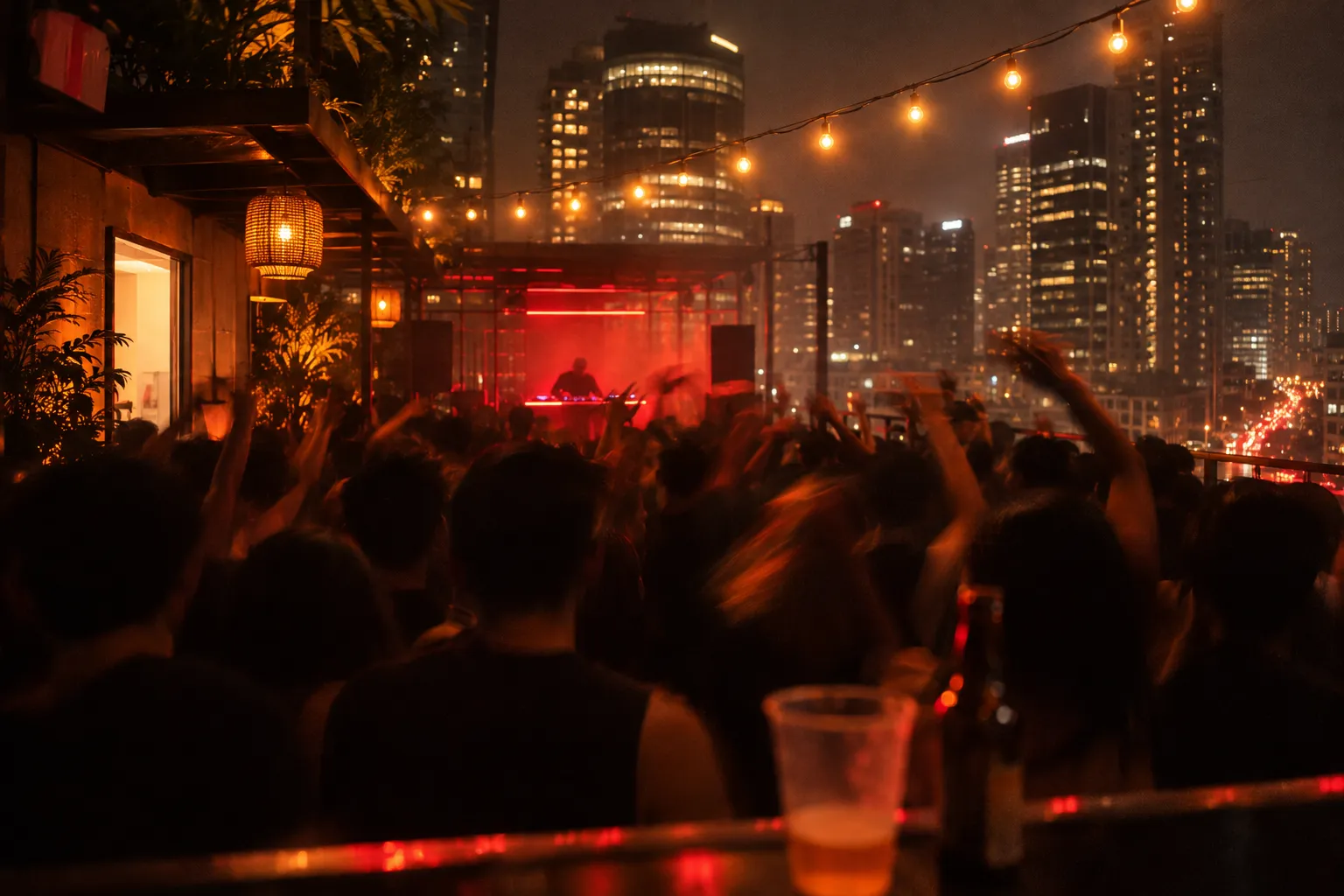
Poblacion is zoned as residential rather than commercial under Makati’s ordinance, according to Vice, and a lifelong resident told the magazine she recognised her own neighbourhood less every year. She described complaining to a bar at 2:30 in the morning and getting the volume turned down only once she mentioned the police. A Makati official said inspectors check noise levels and send repeat offenders up to city hall, which decides the consequences.
An Inquirer piece I found, which I couldn’t date, says Makati follows the national community noise guideline of 80 decibels and that a councilor wanted Poblacion reclassified so the city could write stricter rules. I couldn’t confirm that anything changed. So what I take away is practical rather than legal: the street is a negotiation between people who sleep there and people who come to drink, and a late night can end with the police arriving over a speaker.
A Beer Costs Anywhere From Pocket Change to a Real Bill
The price guides disagree, and I’d rather show the spread than pick one number. One Poblacion guide puts a San Miguel at ₱80 to ₱130 ($1.26 to $2.04), while another quotes ₱200 to ₱350 ($3.14 to $5.50) at live-music bars. A third guide says Ermita bars run ₱50 to ₱80 ($0.79 to $1.26) for local beer. All dollar figures here use ₱63.67 to the dollar, the rate published on 19 November 2026.
Cover charges are where the districts really separate. One guide says Poblacion bars often charge nothing at the door, and that walk-in entry at Bonifacio Global City clubs runs ₱500 to ₱1,000 ($7.85 to $15.71), with table minimums starting around ₱3,000 ($47.12). I’d treat those as rough, since they come from travel blogs of uncertain age, and a craft-spirits bar I read about in Poblacion listed bottles from ₱1,800 ($28.27). The pattern is what matters: the same city sells you a ₱80 bottle and a ₱3,000 table within a few kilometres.
The Liquor Rules Changed Fast During the Pandemic
Grid Magazine reported that liquor bans and curfews could take effect overnight during the pandemic, and that Makati even set businesses a limit on how many alcoholic drinks they could sell and required them to serve food. Those were emergency measures, and a Makati public-drinking ordinance from July 2020 was tied to a state of calamity. I found no current closing-time rule for Poblacion, so I won’t quote one.
The drinking age is reported as 18, though a 2022 House bill proposed raising it to 21 and I couldn’t confirm what became of it. I’m not a source for the law, and anyone going out should check the city’s own records instead of a notebook. The reason I mention it at all is that the rules in this city have shifted quickly before, and I’d assume they can again.
How This Fits With Dating Here
When I think about dating in the Philippines, the bars aren’t where I’d begin. The Tinder in the Philippines piece covers the app side, and the wider habits are in dating in Asia as a Western man. Poblacion is a place to meet people who are already out, and that is a different thing from a place where anything is promised.
What it shares with Hong Kong is the sense that the district is a small, dense, expensive stretch of an otherwise ordinary city, and that most of the people on it are locals having a night out rather than extras in a foreigner’s trip. I try to keep that straight in my head before I order anything.
Questions About a Night Out in Manila
Where do most visitors go out in Manila?
Poblacion in Makati, according to nearly every guide I read, with Bonifacio Global City for pricier clubs and Ermita and Malate for the older bar streets. PhilSTAR Life describes Pobla as the younger, more local scene.
Is Poblacion a residential area?
Yes, because Vice reported that Makati’s zoning ordinance classes it as residential rather than commercial, which is why residents and bars keep clashing over noise.
How much does a beer cost in Poblacion?
Sources range from ₱80 to ₱130 ($1.26 to $2.04) at ordinary bars to ₱200 to ₱350 ($3.14 to $5.50) at live-music venues. None of the guides I found is recent enough to treat as a current menu.
Is there a closing time?
I couldn’t find a verified current rule for Poblacion. During the pandemic Makati did impose curfews and drink limits, but those were emergency measures.