A love hotel in Japan charges for a block of time rather than for a night, and the block you happen to walk in on decides almost everything about what the room costs you. Pasha Group, which runs four of these places around Shinjuku, publishes a three hour rest at ¥4,500 to ¥7,000 ($28 to $44) on a weekday and an overnight at ¥6,500 to ¥12,000 ($41 to $75) from Sunday to Thursday. I have paid both of those in the same week for rooms that were effectively identical to each other. The difference was the hour I arrived, and that is the part nobody explains before you are standing in front of the panel.
A love hotel sells blocks of time, not nights
What you are buying is a room for a defined stretch of hours, priced by when that stretch starts and how long it runs. Wikipedia’s account of the trade counts roughly 37,000 love hotels across Japan and more than 500 million visits a year, which works out at around 1.4 million couples, or 2 percent of the population, using one on any given day. That scale is the thing most foreign coverage keeps skipping past. These are not a curiosity laid on for tourists, they are ordinary municipal infrastructure in a country where a great many adults live with their parents or behind walls you can hear through.
The category sits under the Businesses Affecting Public Morals Regulation Law, which puts it under police jurisdiction and was amended in 2010 in a way that blurred the line between a love hotel and a regular one. That line is now vague enough that plenty of these buildings market themselves to travellers as design hotels with jet baths. The pricing structure is what still gives the category away every single time.
Rest, free time and stay are three different prices
Rest, free time and stay are the three products on the board, and they overlap in ways that punish anybody guessing between them. A rest, written 休憩 and pronounced kyūkei, is the short block that typically runs one to three hours, and Pasha Group prices its Shinjuku three hour rest at ¥4,500 to ¥7,000 ($28 to $44) from Monday to Friday and ¥5,000 to ¥8,000 ($31 to $50) at weekends and on public holidays. Japan-guide gives a wider national range for the same product at ¥4,000 to ¥8,000 ($25 to $50), which is roughly the spread you find once you leave the centre of a big city.
Free time is the block that almost nobody writes about and the one that changes the arithmetic completely. Pasha Group sells around twelve hours of it for ¥5,000 to ¥7,500 ($31 to $47) on a weekday, which is less than some of its own three hour rests and a long way underneath an overnight. The catch is that free time runs across the dead part of the day, so what you are getting is a room from the morning through the afternoon rather than one through the night. Stay, written 宿泊 and pronounced shukuhaku, is the overnight product at ¥6,500 to ¥12,000 ($41 to $75) from Sunday to Thursday, rising to ¥7,000 to ¥15,000 ($44 to $94) on Friday, Saturday and holidays. Every figure here converts at about ¥159 to the dollar, which is where the rate sat on the morning I wrote this.
The ten o’clock line is where the money moves
Overnight pricing does not become available until 22:00, and arriving before that line is the most expensive ordinary mistake the building has to offer. Wikipedia states the rule plainly and every rate board I have read in person has enforced it without exception. Turn up at nine in the evening intending to sleep there and you are buying a rest first and then paying again to convert it into a stay, or paying an extension on top of it, while the overnight rate you actually wanted sits an hour away on the clock.
I have done exactly this myself, going into a place off Dogenzaka at about half past nine because it had started raining and I could not be bothered to think it through. The cheerful thing about love hotels is that nobody at the desk is going to talk you out of a bad decision, because there is usually nobody at the desk at all. The room itself was perfectly fine and the bill came to half again what it needed to be, entirely on account of thirty minutes. The same failure runs through a night at a kyabakura, where the set quietly expires and buying another one feels like nothing, and it is why I now look at the clock before I look at the room photographs.
The panel and the window are built to avoid your face
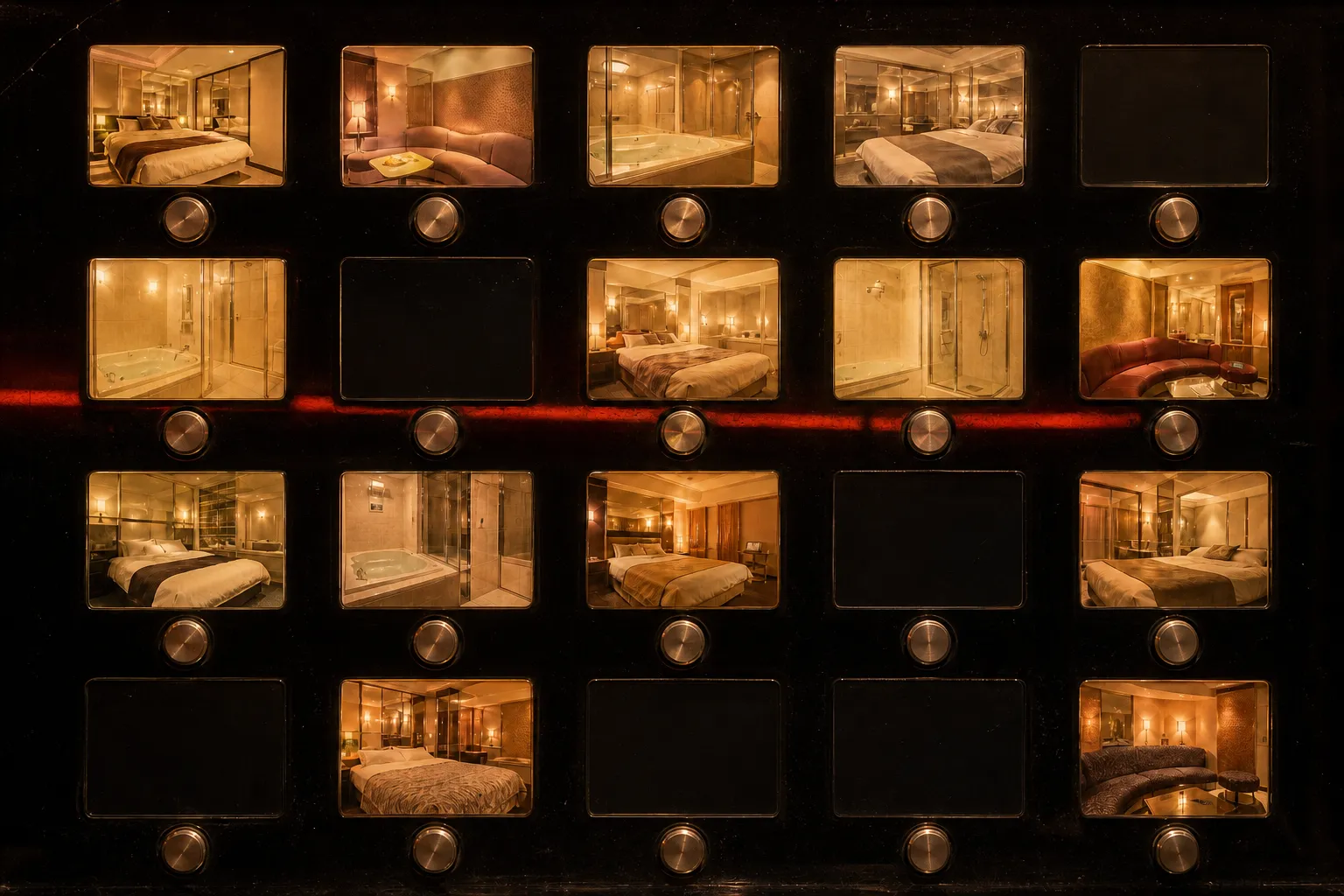
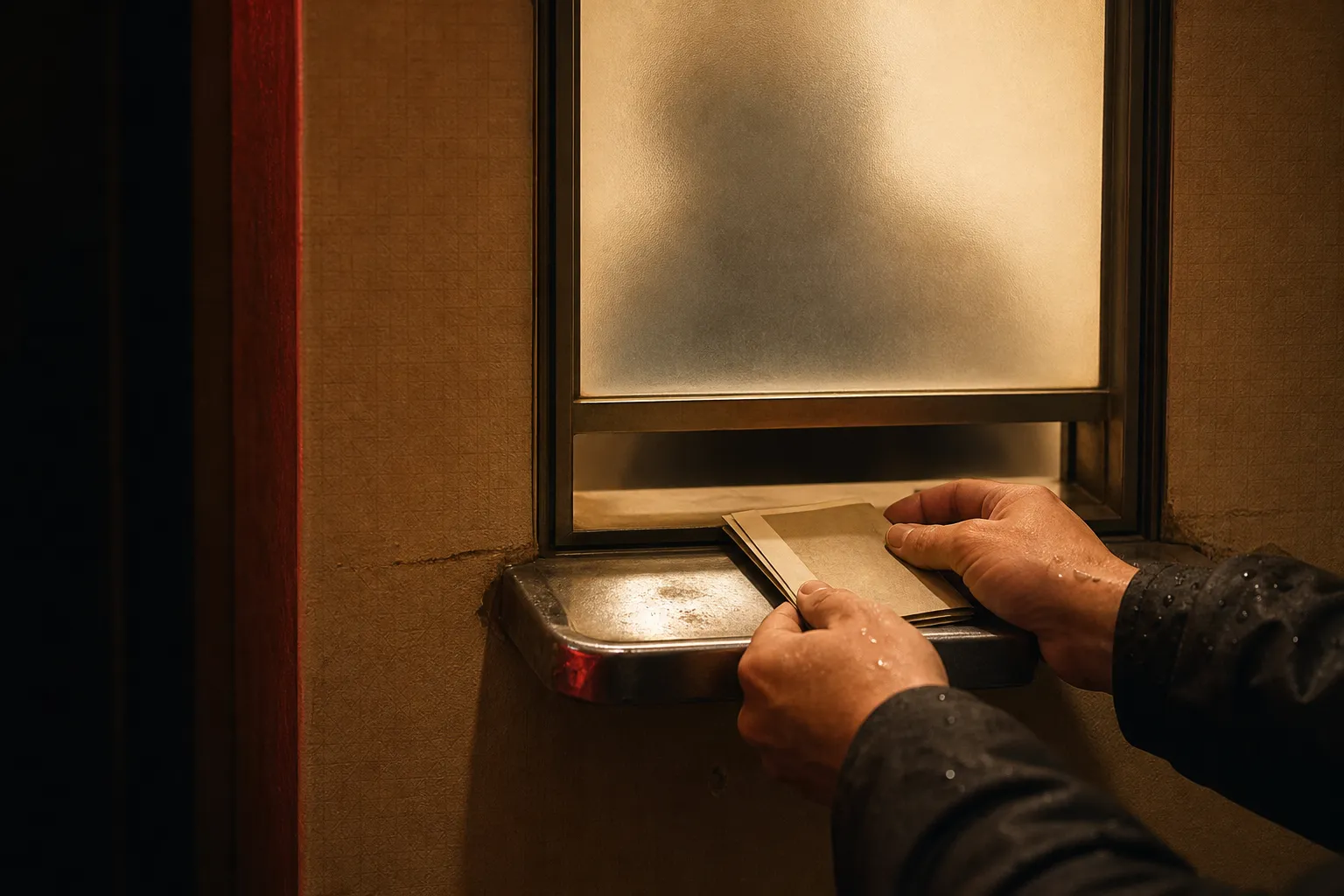
Checking in is engineered so that no member of staff ever gets a proper look at you, and knowing the sequence in advance removes most of the awkwardness. You walk into a small lobby holding a lit board of room photographs, the darkened ones are the rooms already taken, and you press the button underneath the one you want. Japan-guide describes precisely this arrangement and notes that payment then happens at a small window where the receptionist behind it cannot be seen. Wikipedia lists the fuller set of methods still working across the country, including pneumatic tubes, vending machines and that pane of frosted glass.
The genuinely awkward part for a foreigner is not the anonymity, it is that the panel is frequently Japanese only and the figures beside each room are two rates rather than one price. I have stood in front of one of these boards trying to work out which number was the rest and which was the overnight while somebody waited politely behind me in the doorway. Photographing the board and running it through a translation app takes about twenty seconds and has saved me real money more than once. Nobody minds you doing it, because nobody is watching you at all, which is the entire proposition of the building.
The couple rule is what actually gets people refused
The rule that turns people away at the door is not about your nationality, it is about arriving as a couple. Pasha Group states the basic rule as checking in two at a time, notes that a growing number of love hotels now accept same-sex couples or larger groups, and tells you to confirm with the individual hotel beforehand rather than assuming. The same operator is explicit that nobody under 18 may use a love hotel under the Entertainment Business Law, and that this applies to foreign customers on exactly the same terms as it does to Japanese ones.
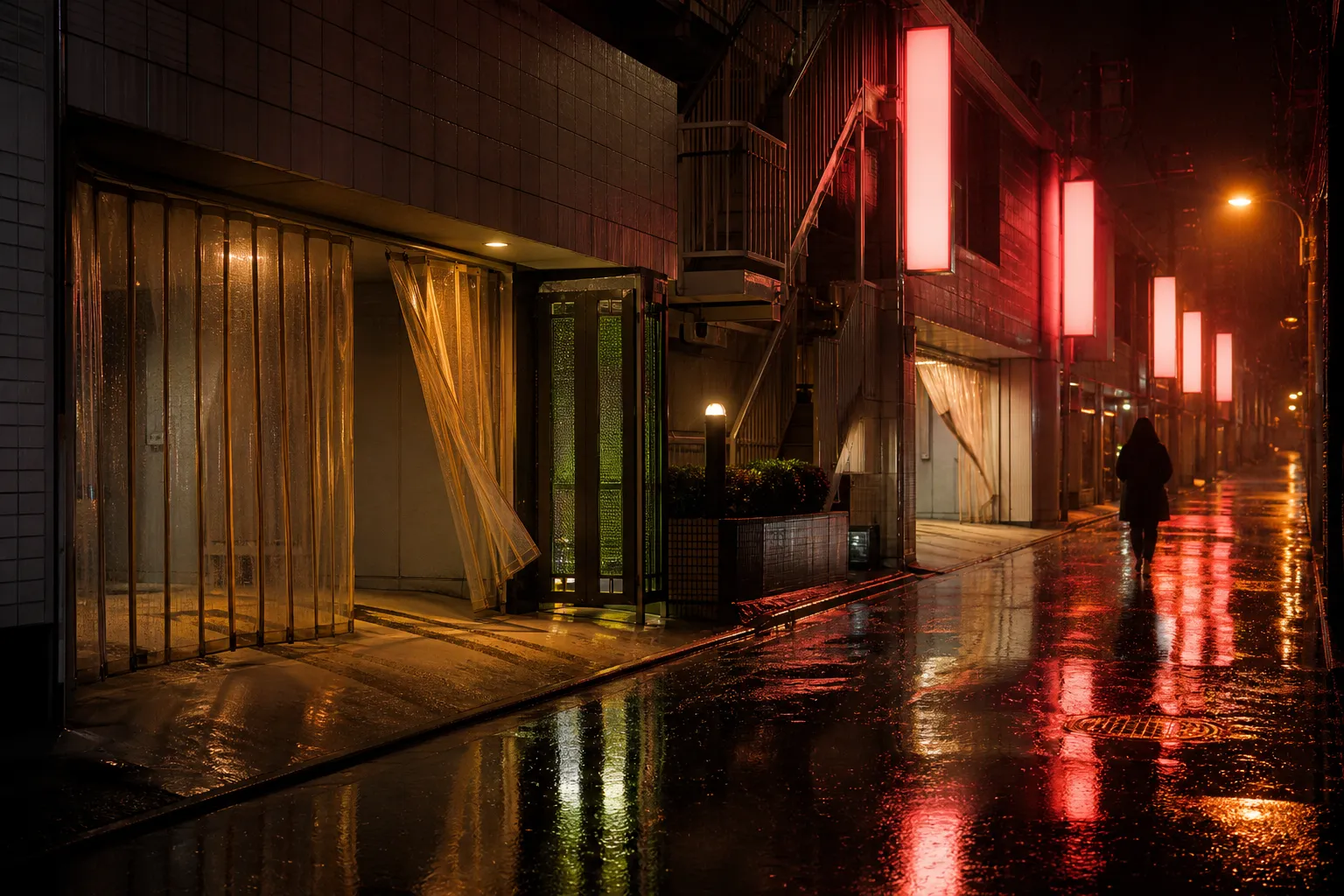
Being foreign is close to a non-issue in the districts where these hotels cluster together, and it becomes an issue in quiet residential ones where the staff have no particular reason to be set up for you. That is the same geography I ran into at Tobita Shinchi and at happening bars, where the door policy is a local calculation rather than a national one. A place used to visitors will process you without a flicker of interest, a place that is not will find some reason, and neither of those is worth taking personally at eleven at night in the rain.
What I budget, and when I skip the whole thing
I budget ¥12,000 ($75) for an overnight in Tokyo at the weekend and I am usually pleased to end up paying less than that. On a weekday away from the centre I plan for ¥8,000 ($50) and treat anything much under it as a sign the room will be older than the photograph on the panel suggested. For a rest I use ¥7,000 ($44) as my ceiling and walk out if the board wants more, because in any district that has one of these at all there is another within about two streets.
The case for a love hotel over a business hotel is about the room rather than the money, since the bath is enormous, the walls were built for the purpose and nobody in the building has the slightest interest in you. The case against is that the cheap end of this market is genuinely tired and the arithmetic falls apart the moment you want to hold the room across the boundary between two blocks. I skip it entirely when I need a base for several days, because these places are priced for hours and they punish anyone treating them as accommodation. Everything I have learned about money while dating across Asia points the same way, which is that the advertised number is rarely the final number, and the boundary conditions are where the difference actually lives.
Can foreigners use a love hotel in Japan?
Yes, and in the main city districts it is completely unremarkable. Pasha Group’s own guidance applies its age rule to foreign customers on identical terms rather than adding extra conditions for them. Quieter neighbourhoods are less predictable, and a hotel that is not set up for non-Japanese guests will usually decline rather than explain itself.
How much does one night in a love hotel cost?
An overnight around Shinjuku runs ¥6,500 to ¥12,000 ($41 to $75) from Sunday to Thursday and ¥7,000 to ¥15,000 ($44 to $94) on Friday, Saturday and holidays, on Pasha Group’s published rates. Japan-guide’s national figure for the same overnight product is ¥8,000 to ¥14,000 ($50 to $88). Both of those assume you are arriving after ten in the evening rather than before it.
Can one person check into a love hotel?
The advertised rule is that you arrive as a couple, so a single guest gets refused at a fair number of places and quietly waved through at others. It varies by individual property rather than by city, and the panel in the lobby will not tell you which sort you have walked into. Asking the hotel in advance is the only reliable method, which rather defeats the anonymity you came for.
Is a love hotel cheaper than a business hotel?
For one night at the weekend it frequently is, and across a run of several nights it is not. A business hotel prices by the night, so consecutive nights stay flat, while a love hotel resets its clock and expects a fresh block from you each time. The bath is better in the love hotel and the arithmetic is better in the business hotel, and I have never once regretted choosing on that basis.