A noraebang is a private Korean karaoke room rented by the hour or by the song, and under Korean law it’s classed as a singing practice room rather than a bar. That classification is why the front desk won’t sell me a beer, why a room full of adults is expected to sing sober, and why the version with drinks and company on the menu turns out to be a different business under a different licence. Every guide I read before my first one told me it would be fun, and not one of them told me that part.
The Legal Name Is Singing Practice Room
The word on the sign is noraebang, song room, but the word on the registration certificate is noraeyeonseupjang, which means a place for practising songs. The Music Industry Promotion Act defines the business as a room fitted with accompaniment equipment and offered to the public without any live performer, and that dull definition does a surprising amount of work. It files the whole industry next to record shops and music distribution rather than next to pubs.
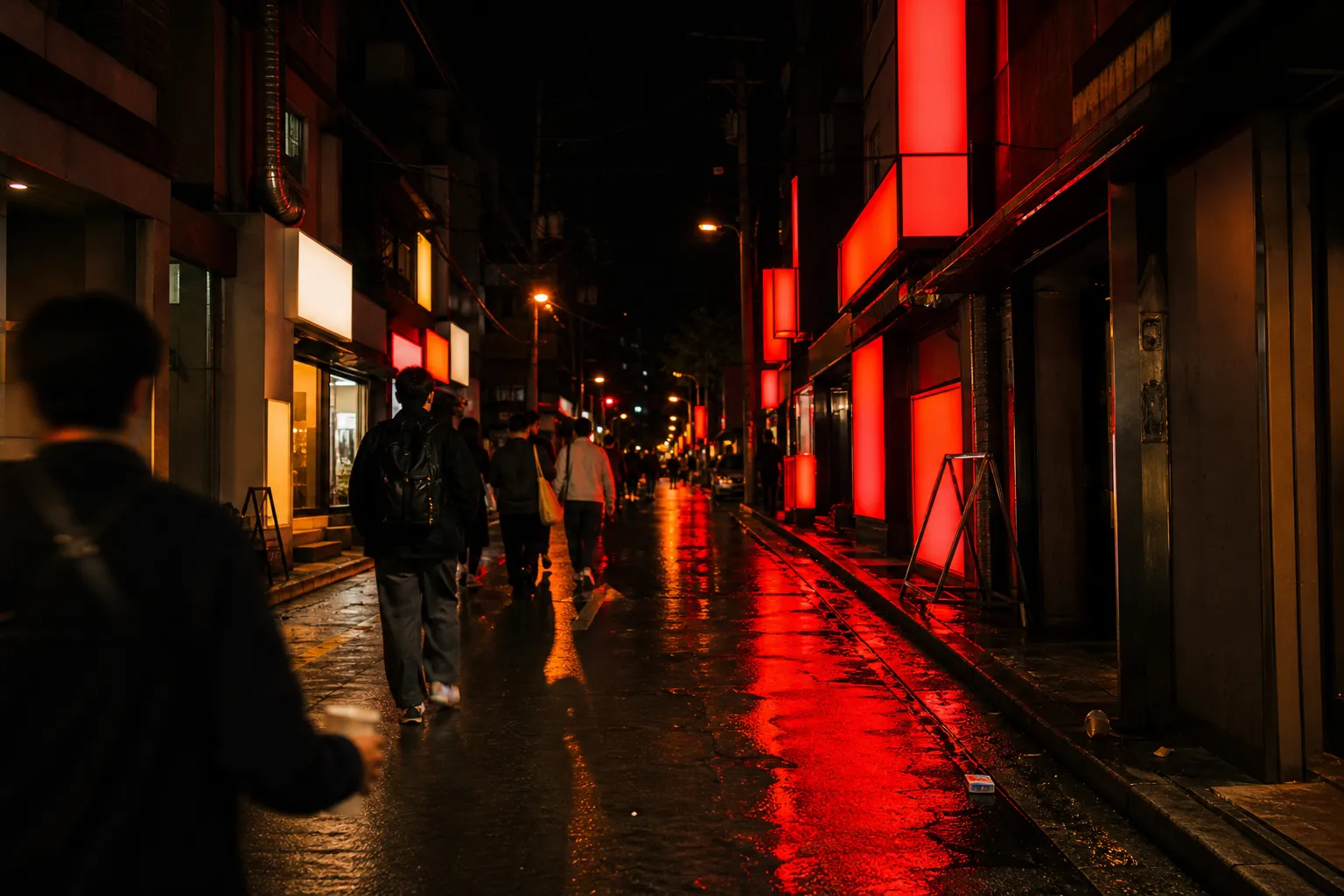
I only went looking for the law because the first time I asked for a beer at a noraebang counter in Seoul, the man behind it looked at me as though I’d asked him to fill the tank of my car. The rooms looked like somewhere people drank. The sofas were vinyl, the lights spun, and the tables were sticky in the way that only spilled soju makes a table sticky. That turned out to be a history of the room rather than a promise about it.
The Law Bans Alcohol and Hostesses
Article 22 of the Act lists what a noraebang operator must do, and two of its lines explain most of the confusion foreigners carry into these rooms. The operator must not sell or provide alcohol, and must not hire or arrange hosts of either sex or tout for customers on the street. The enforcement decree goes a step further than the Act: the operator may not keep alcohol on the premises at all, and may not quietly allow customers to carry it in.
The penalties are not the soft kind. An operator who employs or arranges hosts faces up to three years in prison or a fine of up to 30,000,000 won ($22,124). Selling alcohol, or letting minors in outside their permitted hours, carries up to two years or 20,000,000 won ($14,749). Since an amendment of 22 October 2024 the law also reaches the person in the room, not only the owner, so anyone who drinks with customers or entertains them with song or dance for money in a noraebang, or arranges for someone else to, faces up to a year or 3,000,000 won ($2,212).
Every conversion in this post uses 1,356.04 won to the dollar, the rate published on the morning I wrote it.
The same amendment gave operators the power to demand an ID card at the door and to refuse entry to anyone who won’t show one. Teenagers are allowed in between 9am and 10pm only, unless they come with a parent or a guardian. I’ve never been carded at a noraebang, which says more about my face than about the law.
The Rooms With Drinks Are a Different Licence
A room where I can sing and drink at the same time is legal in Korea, but it isn’t a noraebang in the legal sense, because it runs on a food sanitation licence instead of a music industry one. The Food Sanitation Act’s enforcement decree has two relevant categories. A danran jujeom is a business that mainly sells alcohol and lets customers sing. A yuheung jujeom is a business that mainly sells alcohol, lets customers sing and dance, and may employ entertainment workers and install entertainment facilities.
That second category is where the hostess rooms live, and it’s the honest answer to the question that sits at the top of every English search for this word, which is some version of what the women in the noraebang are for. In a noraebang registered as a noraebang, legally, there are no women provided for anything. When a room offers drinks and company, it’s either licensed as something else, which changes the bill entirely, or it’s breaking the law I just quoted, which changes something worse than the bill.
I think of it as the Korean cousin of the split I wrote about in Japan between a snack bar and a kyabakura, where two rooms look alike in low light and run on completely different arithmetic. Korea just wrote the difference into statute and put a prison term on the wrong side of it.
A Coin Noraebang Charges by the Song
A coin noraebang is a booth-sized version of the same room where I pay per song rather than per hour, and it’s the cheapest night out I’ve found anywhere in Seoul. The Korean wiki Namuwiki, which I checked the morning I wrote this, puts the usual rate at two or three songs for 1,000 won ($0.74), with four songs for the same money in cheaper neighbourhoods and only two in the busy districts where rent is brutal. Unused songs are almost never refunded, so the sensible move is to feed the machine a little at a time.
The older full-size rooms charge by the hour for the whole room, and Namuwiki puts the usual figure somewhere in the 30,000 won range ($22), which is nothing split between five people and a lot for one person on a bad evening. A study-abroad writer at Yonsei paid 6,000 to 8,000 won ($4.42 to $5.90) an hour at the coin chains in 2023, and an English teacher writing for Aclipse quoted about 500 won ($0.37) a song. The prices were never where the money went, and that part at least matches everything the cheerful student guides say.
I’ll add the one thing they left out, which is that in a coin booth nobody is watching the clock except me, and it’s much easier to lose an hour when every song feels as though it costs pocket change.
Noraebang Is Where the Date Tells the Truth
A noraebang late in the evening is the second or third stop on a Korean night out, and on a date it shows me more in twenty minutes than dinner did in two hours. People drink first, somewhere else, somewhere licensed, and then they walk the tipsy half of themselves down a staircase into a room that is legally dry. The sobering effect is real and nobody talks about it.
The first date I ever had that ended in a noraebang was with someone I’d met on one of the Korean dating apps, and what I remember is the remote control rather than the singing. It’s a heavy slab with a grid of rubber buttons and a song catalogue in Korean, English, Japanese and Chinese, and whoever holds it is choosing the mood of the whole room. She took it from me after my second song and I didn’t get it back, which I’ve since decided was the most honest feedback I’ve received in Asia.
A private room with a closed door is also, plainly, a private room with a closed door. Most of the time that means friends singing badly with the lights spinning. I found it useful to remember that a date who suggests a noraebang is usually suggesting exactly that, and that the room’s reputation abroad owes far more to the other licence than to this one. It’s the natural next stop after the bars in Hongdae, where half the buildings have a microphone sign somewhere on their stack of signboards.
Questions I Had Before the First Room
Can I drink alcohol in a noraebang?
Not legally in one registered as a noraebang, because the operator can’t sell alcohol, can’t store it on the premises and can’t knowingly let me carry it in. Some rooms turn a blind eye anyway, but that risk falls on the owner rather than on me. A room that serves drinks openly is almost certainly licensed as a bar.
Are noraebangs connected to the sex industry?
A noraebang registered as one is legally barred from providing hosts of either sex, and anyone paid to drink or sing with customers there has faced a criminal penalty since October 2024. The rumours come from rooms that break that law and from yuheung jujeom venues licensed under food sanitation rules, which are a different business with a different bill.
How much does a noraebang cost?
A coin booth usually runs two or three songs for 1,000 won ($0.74), according to Namuwiki’s page as I read it this week. A full room is typically charged by the hour for the whole group, commonly in the 30,000 won range ($22), and the per-song rate gets worse in the busiest districts.
Can foreigners go to a noraebang alone?
Yes, and the coin booths are built for exactly that, one or two people paying by the song with nobody else in the room. The song catalogue on most machines carries English and Japanese tracks, so the language barrier sits in the remote’s menus rather than in the music.
Nobody warned me that the sober half of a Korean night would happen underground, in a room the law insists is for practice, and after enough visits I’ve decided that’s the most accurate description of what I do in there.