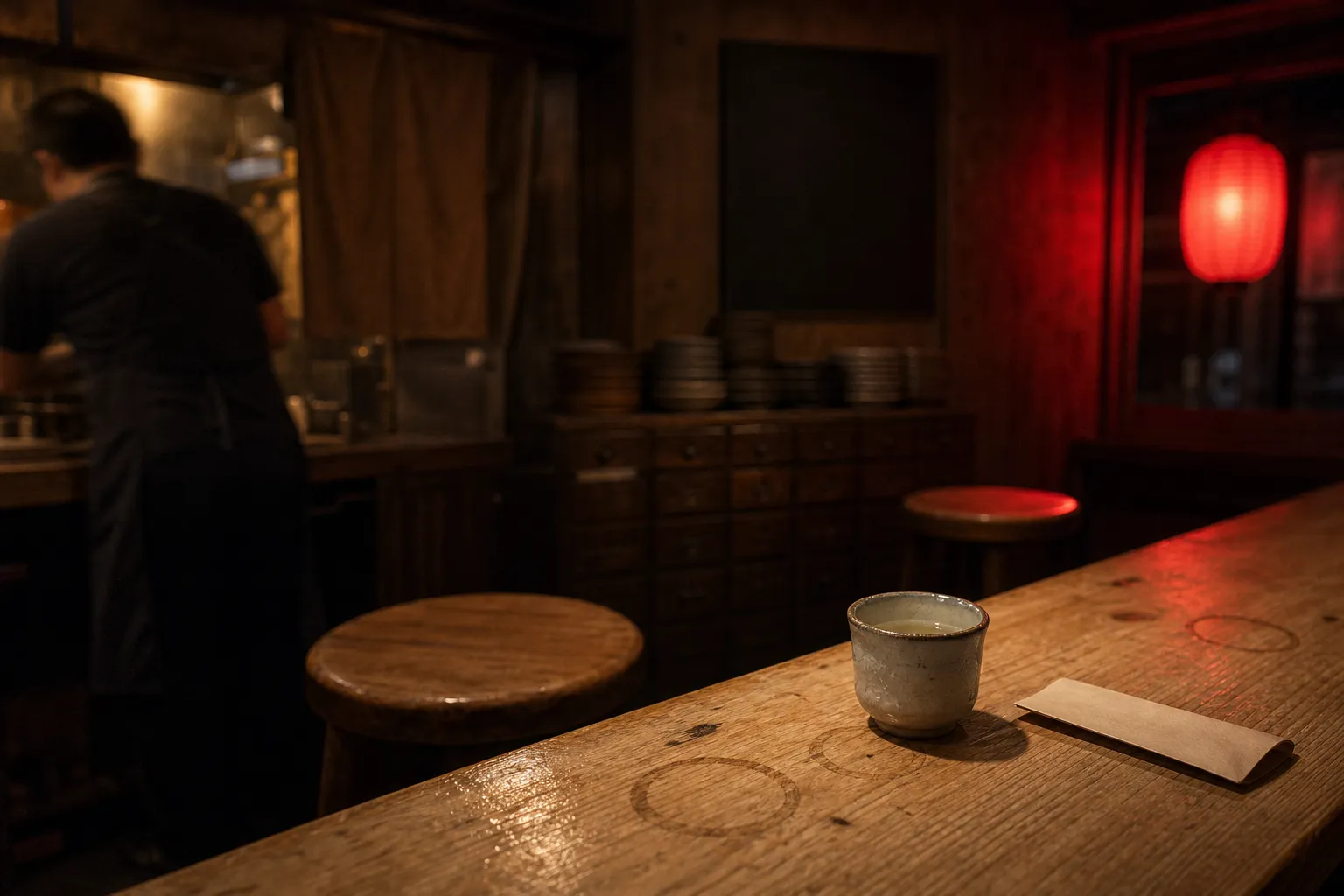
Otoshi is the small dish an izakaya puts in front of me before I’ve ordered anything, and it shows up on the bill as a per-person charge that usually sits between ¥300 and ¥600 ($1.93 to $3.85). It isn’t a gift and it isn’t a mistake, because in practice it works as the seat charge for the evening wearing the costume of an appetiser. In Kansai the same thing is called tsukidashi, and in both places I’ve learned to read it as the price of the stool rather than the price of the food.
Otoshi Is a Table Charge Served on a Plate
The dish exists so that the house gets paid for my seat before I’ve decided how much I’m going to drink. Most of the English explainers describe it as hospitality, a little bite to go with the first beer while the kitchen gets to my order, and the food itself fits that story well enough. I’ve been given edamame, a spoonful of potato salad, simmered daikon, a few pickles, a cube of cold tofu, and once, in a very good place near Kanda, a small piece of grilled fish that I’d have paid double for.
The bill tells the other half of the story. The otoshi line is multiplied by the number of people at the table and it lands whether I touch the bowl or not. Nobody asks whether I want it, and the menu rarely mentions it in English, which is why the first time I saw it I assumed the waiter had put somebody else’s order on my tab.
The Charge Is Mostly Three or Four Hundred Yen
The most common otoshi price is between ¥300 and ¥399 ($1.93 to $2.56), and it’s been drifting upward for years. Synchro Food, the company behind the restaurant trade site Inshokuten.com, surveyed 373 restaurant operators between 9 and 16 August 2023 and published the breakdown in Japanese. Among the places that serve otoshi, 40.4% charged ¥300 to ¥399, 21.2% charged ¥500 to ¥599 ($3.21 to $3.85), 14.4% charged ¥400 to ¥499, and 11.5% were still down at ¥200 to ¥299 ($1.28 to $1.92).
The same survey compared those numbers with 2018, when the ¥300 band held 48.3% of otoshi-serving shops, so the cheap end is shrinking and the ¥500 end is growing. It also found that 20.2% of those shops had raised the otoshi price in the previous year and another 16.3% were thinking about it. That matches my own receipts, where the line that used to read ¥300 now more often starts with a four or a five, and one Tokyo price guide puts upscale kappo counters at ¥500 to ¥1,000 ($3.21 to $6.42) or more for something that arrives in a thimble.
All the conversions here use ¥155.69 to the dollar, the rate published on the morning I wrote this. At that rate the charge looks trivial, and for one person it is, though it stops looking trivial once I start multiplying it by the table.
Fewer Places Charge It Than I Assumed
A minority of Japanese restaurants now charge otoshi at all. In that same Synchro Food survey, 38.2% of respondents said they charged an otoshi fee, 28.7% charged a seat fee, 15.1% charged a service charge, and 29.4% charged none of the three. The company’s own summary notes that some shops have been moving away from otoshi toward a plainly named seat charge, partly because customers, and foreign ones in particular, don’t understand what the little bowl is for.
That shift made sense to me the first time I sat in Golden Gai, where the seat charge is written on the door in marker pen and nobody pretends it’s food. An otoshi is the same money routed through a kitchen, and I’ve come to think the plate is the only reason anybody objects. A charge I can read before I sit down feels like a price, while a charge I discover afterwards feels like a trick, even when the number is identical.
The places that skip it tend to be the ones built for speed. Guides I trust say ramen counters, sushi bars and set-meal shops generally don’t serve otoshi, and in my experience that holds, since nobody lingers at a ramen counter long enough for the seat to need renting.
Two Chains Show the Whole Range
The clearest way I’ve found to understand otoshi is to compare two big izakaya chains that price it in opposite ways. Torikizoku, the yakitori chain, states on its own site that it takes no otoshi fee, no seat charge and no late-night surcharge from customers. I walk into one when I want a bill I can predict to the yen, and it’s the chain I send friends to on their first week in Japan.
Miraizaka, the karaage-heavy chain run by Watami, sits at the other end. Its banquet course page for the Shinjuku east exit branch says the otoshi is an extra ¥330 including tax ($2.12) and adds, in brackets, that it can’t be cut. The same page says anyone arriving after 10pm pays a late-night charge of 10% on top of the menu prices. Neither policy is hidden, since both are on the chains’ own sites, but only one of them is something a visitor would ever think to look up before sitting down.
The late-night charge is the part I never saw coming. Otoshi is a flat few hundred yen, while a percentage surcharge scales with everything I order, and on a long night it quietly costs more than the dish ever did.
Refusing It Works Only at the Door
I can sometimes decline otoshi, but only if I say so as I’m being seated and only at an independent shop with some flexibility. The phrases the guides give are “otoshi wa irimasen”, meaning I don’t need the otoshi, or “otoshi nashi de onegai shimasu”, which asks for no otoshi, please. I’ve tried both, and the result depends on the person holding the menu far more than on the grammar.
At a small place in Koenji the owner shrugged, took the bowl back and never mentioned it again. At a busier spot near Ueno the answer was a polite explanation that it’s the house system, and I paid it. Once the dish is already on the table, refusing it turns into an argument over a few hundred yen, and I’ve never seen that argument end well for the foreigner. Chains like Miraizaka say in writing that it can’t be removed, so asking there only embarrasses both of us.
What I do now is simpler and less awkward than refusing. If I’m only stopping for one quick drink, I pick a chain that doesn’t charge it or a bar with its charge posted on the door. If I’m staying for two hours, I treat the otoshi as the rent on the table and stop thinking about it.
On a Date It Changes Who Looks Careless
Otoshi matters more on a date than on a night out with friends, because it’s the one line on the bill that makes a foreigner look either clueless or cheap. The worst time it caught me I was halfway through a second date with someone I’d met on Tapple, and I asked, too loudly, why we’d been charged for the beans. She explained it kindly, which was worse than if she’d laughed, and I spent the rest of the evening feeling like the tourist I obviously was.
Two people at ¥400 each is ¥800 ($5.14), which is nothing to argue about and everything to be seen arguing about. The lesson I took was to learn the system before the date instead of during it, so that the bill becomes a boring piece of paper rather than a small test of whether I understand where I am. The same logic runs through every paid-for room in Japanese nightlife, from the set charge in a snack bar to the padded tabs upstairs in Kabukicho, where the difference is only how honestly the price gets explained.
In groups the maths gets louder. Six colleagues at ¥500 each is ¥3,000 ($19.27) before anyone has ordered, and I’ve watched a split bill turn tense over exactly that line when one person insisted they’d never touched their bowl.
Questions I Get About Otoshi
Is otoshi a scam aimed at tourists?
No, because Japanese customers pay the same charge at the same shops, and the custom grew out of old sake shops handing a snack across with the drink long before anyone was touring Japan for its bars. It feels like a scam only because nobody explains it in English, which is a communication failure rather than a trap.
Do I have to eat the otoshi?
I don’t have to eat it, but I pay for it either way once I’ve accepted the seat. Leaving it untouched doesn’t remove the charge, so I usually eat it, and some of them have been better than the dishes I ordered on purpose.
Is otoshi the same as tsukidashi?
They’re the same charge under two names, with tsukidashi being the more common word in Kansai around Osaka and Kyoto. The price range and the logic behind it are the same in both places.
How do I know in advance whether a place charges otoshi?
I ask at the door with “otoshi wa arimasu ka”, which simply asks whether there is one, and most staff answer straight away. The big chains state their policy on their own sites, the way Torikizoku and Miraizaka both do, so a thirty-second search settles it before I leave the hotel.
The bowl is small enough that I can pay it without noticing, and that’s exactly why it’s worth noticing once, early, before it turns up on a bill I’m splitting with someone I’m trying to impress.