Nakasu is Fukuoka’s entertainment district, and almost every page written about it repeats that roughly 3,500 restaurants and bars are crammed onto the island. The 2021 economic census counted 887 food and drink businesses across its five chome, employing 4,657 people between them. Neither figure means much standing alone, but the distance between them tells you something useful, because a district nobody can count accurately is also a district nobody can quote you a price for in advance. What Nakasu does have is one small class of business the city legally obliges to show me a number before I sit down, and then everything else, where the number turns up afterwards.
Nakasu Is One Island and It Takes Ten Minutes to Cross
The whole district is a sandbank sitting between two rivers, the Nakagawa on one side and the Hakatagawa on the other, running about a kilometre end to end and never wider than two hundred metres. That makes it a strip rather than a quarter, divided into five chome, and I can walk its full length in the time it takes to finish a cigarette outside somebody’s closed shutter. Kuroda Nagamasa had the place built in 1600 to join what are now Chūō ward and Hakata ward, and the island carries eighteen bridges today. Nakasu-Kawabata Station on the city subway drops you onto the northern end of it.
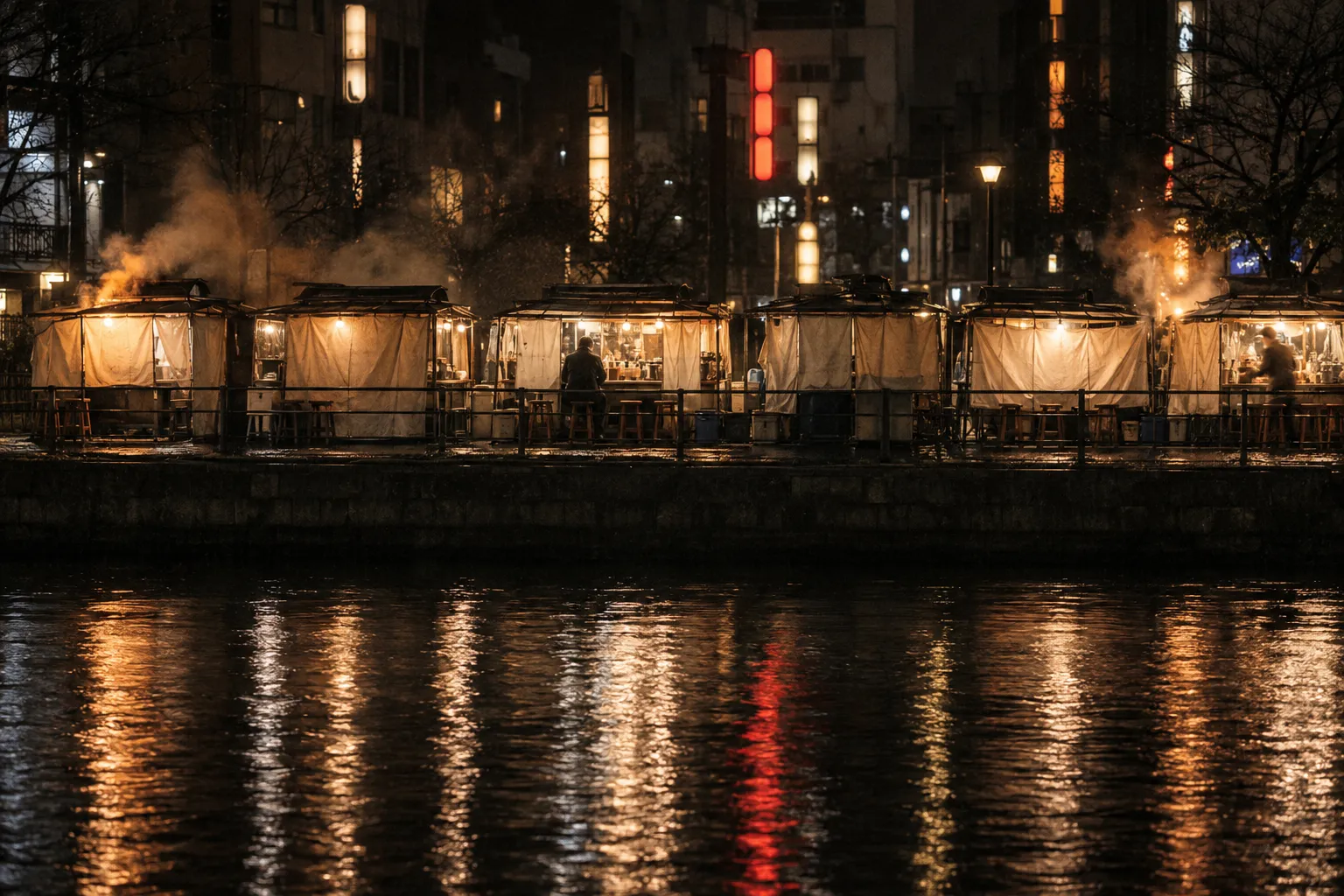
Six hundred and ninety one people actually lived on the island in 2023, which surprised me more than any of the nightlife statistics did, and the residential count has roughly tripled since the early 2000s. The standard land valuation in Nakasu 4-chome rose 20.7 per cent in 2024 alone. So the island is at once the biggest drinking district in western Japan and a residential address where a few hundred people put their bins out.
The Census Counts 887 Places, Not 3,500
The commonly quoted figures for Nakasu are not sourced to anything, and the official ones are considerably smaller. English Wikipedia gives the number of restaurants and stores including adult-entertainment businesses as approximately 3,500 and says over 60,000 people visit every night, and both of those claims sit there flagged as needing a citation. Japanese business coverage repeats either about 2,000 establishments or about 3,500, along with a figure of roughly 30,000 people working there, without saying where any of it came from, and Fukuoka’s own travel-trade material puts around 2,000 eating and drinking places on the island.
Against all of that sits the one count somebody actually went out and collected. The 2021 Economic Census of Business Activity counted 887 food and drink establishments across Nakasu 1-chome to 5-chome, with 4,657 employees. That’s a quarter of the headline number of businesses and roughly a sixth of the headline workforce.
I don’t think the inflated version is a lie in any deliberate sense, because it’s older folklore that nobody has had a reason to check. But the same habit that quadruples a district’s business count in casual retelling is the habit that later assembles a bar bill out of charges nobody mentioned, and I’ve learned to treat a place that can’t tell me how big it is as a place that won’t tell me what it costs. Kabukicho works on the same principle at a larger scale, and the warnings written about Tokyo transfer here almost word for word.
The Yatai Are Legally Obliged to Show a Price
The food stalls on the island have a written duty to display their prices, and as far as I can tell that makes them the only frontages in Nakasu with one. Fukuoka City Ordinance 43, the yatai basic ordinance, was promulgated on 1 July 2013 and came into force that September, and the rules issued under it tell operators to display prices somewhere the customer can easily see them. The same clause goes further than I expected on the detail: any item whose price moves with that day’s ingredient cost has to show that day’s figure, and any item sold on more than one pricing tier has to show each tier separately. A stall also has to display its road occupancy certificate where you can read it, and the permit holder has to work the stall personally rather than lease the pitch to somebody else.
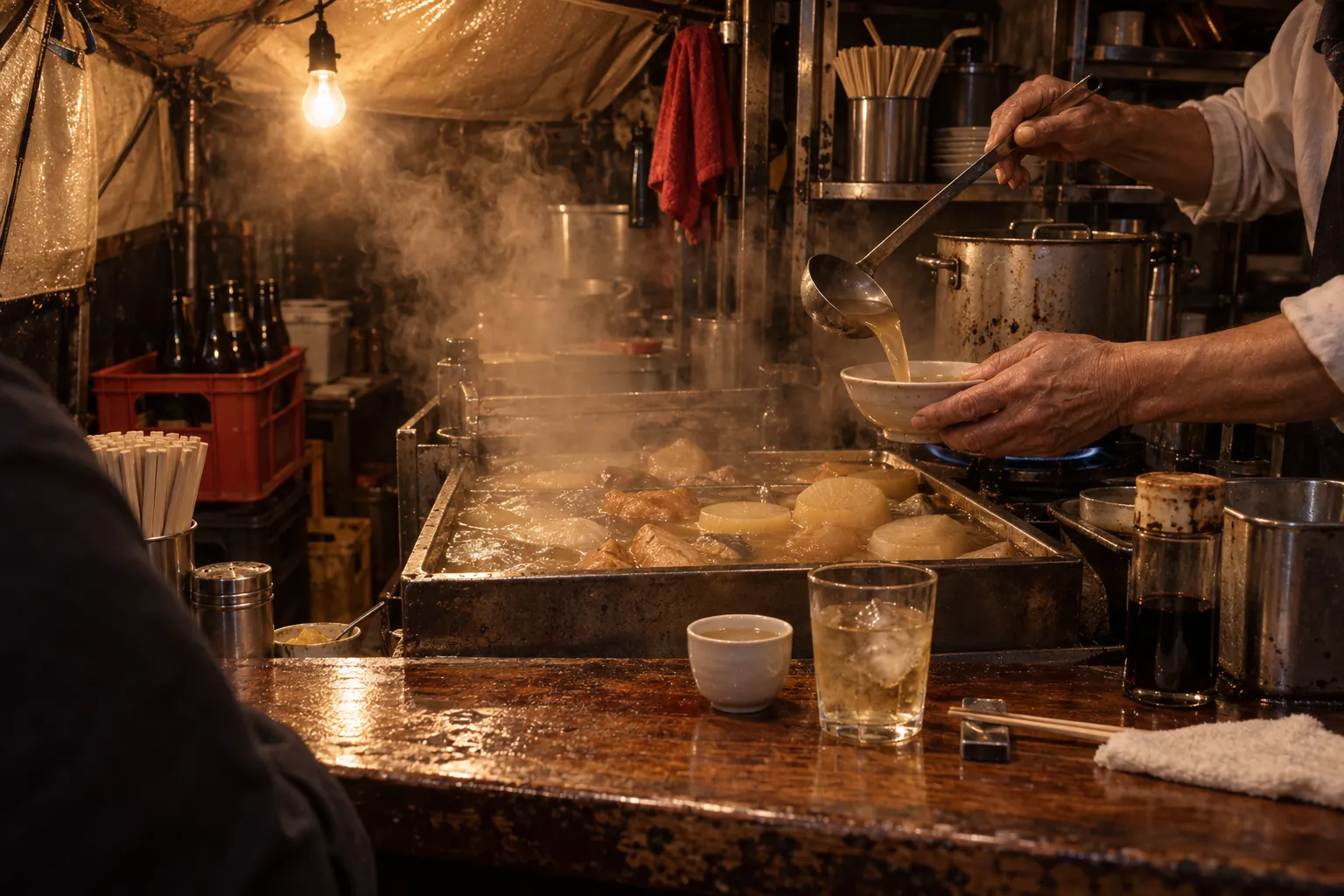
The stalls are also a smaller and stranger business than the postcards suggest. The city had 103 of them holding occupancy permits on public land at the end of January 2024, and the official tourism directory lists 98 across the three areas today, Nakasu and Tenjin and Nagahama. That accounts for something close to nine tenths of every permitted public-land yatai in Japan, because the only other cities running the same licensing arrangement are Kure with ten stalls and Kurume with eight. Each stall is capped at three metres of frontage and two and a half of depth, and a new one costs around 3,000,000 yen ($18,906) built in Japanese cypress by the last specialist maker in the trade.
What all of that buys me is the cheapest honest transaction on the island. The city’s own survey puts average spending at 1,923 yen ($12.12) a head, across an estimated 1,190,700 visits a year, and that estimate comes from a straightforward sum of 105 stalls serving about 45 people a day over 252 trading days. Language is less of a barrier than I assumed as well: when the city surveyed operators in December 2023, 69 stalls had a menu in a foreign language and 39 had staff who could take an order in one. There’s no seat charge convention at a yatai either, which means none of the otoshi arithmetic that governs an izakaya table applies once you’re on a stool at the river.
The Men on the Corner Are Committing an Offence
Street touting in Nakasu is an offence under a Fukuoka city ordinance, and it has been since the first of December 2006. Ordinance 63, promulgated on the twenty-first of September that year, makes it unlawful for anybody in a public place to solicit unspecified people to become customers for services that arouse sexual curiosity, or for hospitality served with food and drink in a manner that creates a pleasure atmosphere, which is the drafting that covers ordinary hostess and club touting rather than only the red-light kind, and imitations of either service are caught by the same wording. Merely standing there is covered too: the ordinance separately bans waiting in public view for the person you intend to solicit, so the man loitering by the kerb is already inside the offence before he opens his mouth. Unlike Sapporo, Fukuoka drew no special zone around its entertainment district, which means the prohibition covers every public place in the city and Nakasu is simply where the trade concentrates.
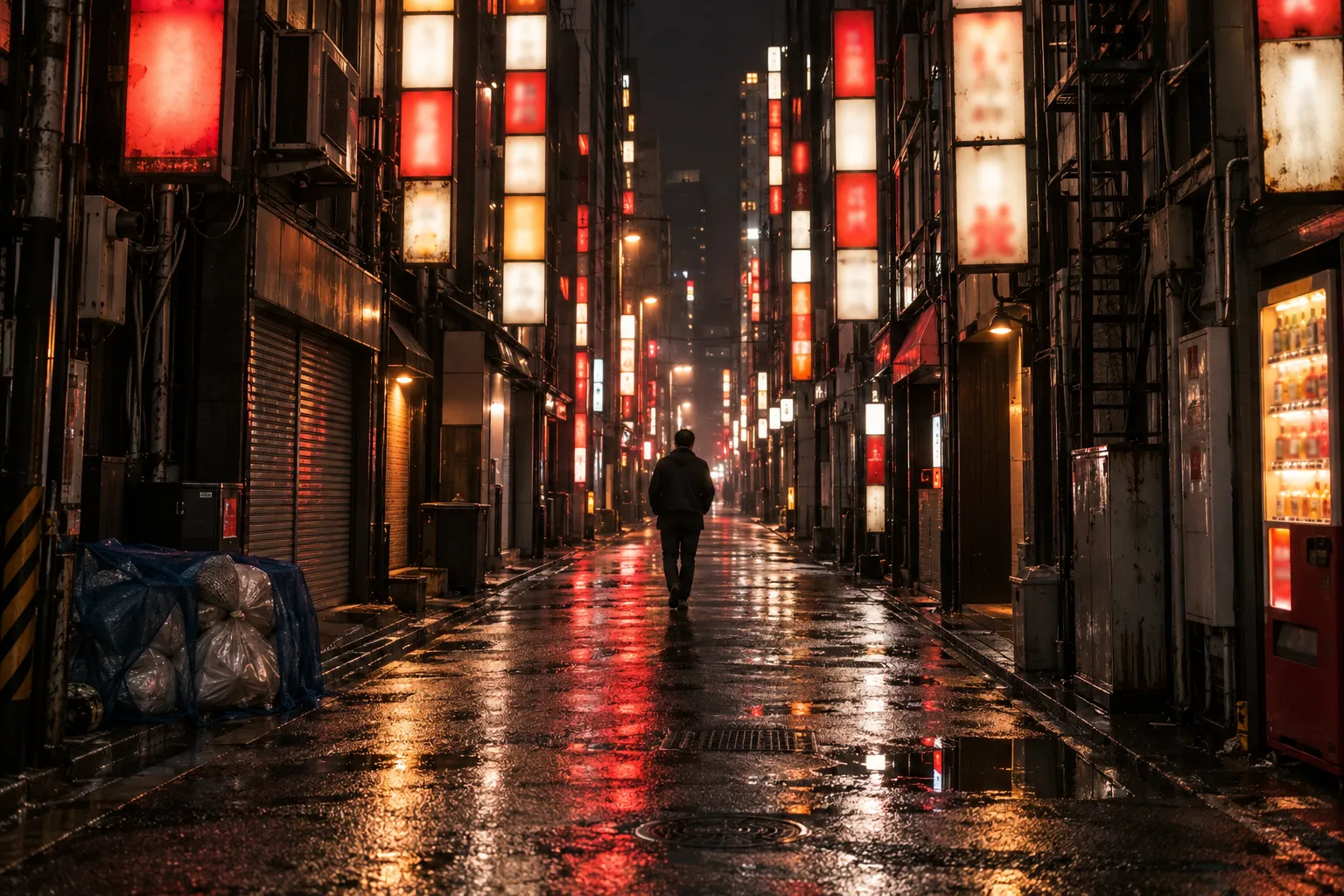
The penalties are heavier than the pavement suggests. An individual faces a fine of up to 500,000 yen ($3,151), or detention, or a minor fine, and anybody doing it habitually faces up to six months of confinement or a fine reaching 1,000,000 yen ($6,303). The clause I find most interesting is the dual liability one, because when an employee commits the offence in the course of the business, the company that sent him out gets fined as well as the man himself.
None of this reaches me at one in the morning, and that’s the part worth being honest about. I’ve walked the island on ordinary weeknights and been approached in English within a couple of minutes of coming up from the subway, which happens to me more often than it happens to the Japanese men walking just ahead. That isn’t personal, it’s arithmetic, because a visitor can’t read the sign plates, won’t cite an ordinance number back at anybody, and won’t be standing on that corner again next Friday in front of the regulars. Susukino in Sapporo runs the identical trade under an identical prohibition, and the men there work just as openly.
What I Actually Spend on a Night in Nakasu
An evening at the yatai runs me somewhere around the official average of 1,923 yen ($12.12) and finishes when I stand up, and every expensive night I’ve had in this district started somewhere else. The two halves of the island price themselves in opposite directions. One has a legal duty to put the figure in front of me and a city department publishing each operator’s compliance record, and the other has a legal prohibition on the sales technique its doors actually rely on, which tells you which of the two rules gets obeyed.
I won’t quote a number for the club floors, because there isn’t a published one and inventing it would be worse than admitting that. What I know transfers from elsewhere: a kyabakura assembles its bill from a set charge, drinks, a nomination fee and a service percentage on top of the whole stack, and no panel on a Nakasu stairwell carries any of those figures. The way I’ve stopped losing money here is dull and it works, which is to ask for the seat charge and the time block out loud before my coat comes off, exactly as I would at a door in Golden Gai where the charge is painted on the wood.
How many bars are there in Nakasu really?
The 2021 Economic Census of Business Activity counted 887 food and drink establishments in Nakasu 1-chome to 5-chome, employing 4,657 people. The widely repeated figure of about 3,500 businesses, along with the claim of 60,000 nightly visitors, has no source attached to it anywhere I could find.
Are the Nakasu yatai obliged to show their prices?
Yes, and the obligation is written down rather than customary. The rules made under Fukuoka’s 2013 yatai basic ordinance require prices to be displayed where a customer can easily see them, with that day’s figure shown for anything priced off daily ingredient costs and every tier shown separately where an item has more than one.
Is it illegal for touts to approach me in Nakasu?
It is, under Fukuoka City Ordinance 63, in force since December 2006. Soliciting strangers in public for sexual services or for hospitality drinking carries a fine of up to 500,000 yen ($3,151) for an individual and up to 1,000,000 yen ($6,303) for a habitual offender, and the employing company is liable alongside the tout.
Can I use a Nakasu yatai without any Japanese?
Usually, though it varies by stall rather than by area. The city’s December 2023 survey of operators found 69 stalls with a foreign-language menu and 39 with staff able to serve in a foreign language, out of roughly a hundred trading, and the official tourism directory lets you filter for both.
Nakasu is the only district I’ve written about where the city has bothered to legislate a duty to quote a price, and it applied that duty to the stalls selling ramen for twelve dollars rather than to the buildings where the money actually goes. All yen figures here convert at 158.69 to the dollar, the rate on the day I checked it.